
BOOK REVIEW: New work on 25 years of FOCAC debuts to enrich Africa-China information pool
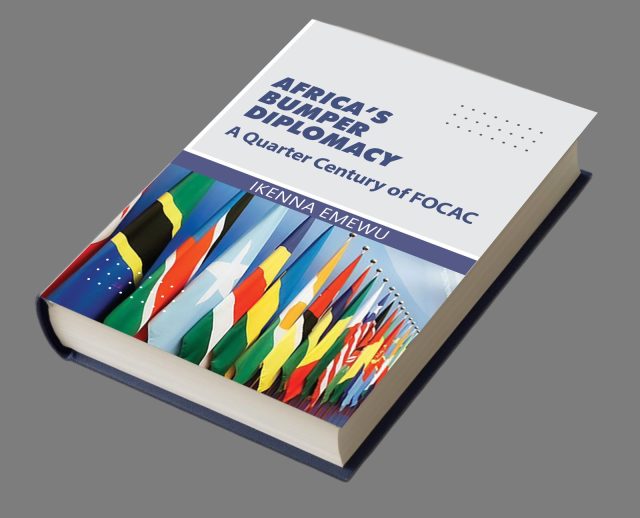
Book Title: Africa’s Bumper Diplomacy: A Quarter Century of FOCAC
Author: Ikenna Emewu
Publisher: Afri-China Media Centre, Lagos, 2026
Structure: Paperback
Pagination: 348 pages
Chapters: Eleven
Foreword: Yan Yuqing, Chinese Consul General, Lagos
This is an intellectual, well-researched book on the Forum on China Africa Cooperation (FOCAC) taking a detailed look at its 25 years of existence, between year 2000 and 2025.
The book title of bumper diplomacy for Africa is most apt as FOCAC has proven to be the most beneficial continental diplomatic framework involving the continent. The dimensions of the gains are diverse and deep.
Because these gains have impacted African countries in so many ways, it was, therefore, expedient to have them documented.
On October 10, 2000, 44 African ministers assembled in Beijing for the inauguration of the Forum on China Africa Cooperation (FOCAC).
It was meant to be just a ministerial session with an objective of assembling ministers from some African countries and China to discuss a future relationship.
Six years later, the creation evolved and morphed into a full summit of presidents of African countries and that of China, with a far-reaching agenda and objectives.
In the 25 years of that novel diplomatic creation, the humble FOCAC has evolved into a behemoth with volumes of stories of success to tell.
Coincidentally, that was the same year London’s The Economist magazine in the month of May wrote that Africa was a ‘hopeless continent, and said that the world might give up on the entire continent.’
The influential magazine screamed on the cover of its May 13, 2000, edition, The Hopeless Continent portraying Africa as only good for wars, diseases, and poverty, with almost no hope of improvement.
Even though that was so loud and completely distressing, but from the demonstration of China and the view of two Chinese authorities on Africa, that only represented the Western side of the view. The fact was that China believed that Africa would be a promising continent, and had been ready to build a new platform with Africa for shared development. Five months later, in October 2000, FOCAC was founded in Beijing, and has done well, contrary to the predicted hopelessness.
These landmarks of FOCAC have been possible through the extra verve President Xi Jinping breathed into it.
Xi’s days in power will go down in history as the golden and blossoming era of the relationship between Africa and China in every perspective. Indeed, FOCAC moved from crawling to flying and all the engagements became the business of heads of government. It is also within this period that three African countries, including The Gambia (March 2016), Sao Tome and Principe (December 2016) and Burkina Faso (May 2018) restored diplomatic relations with China.
Most of the high-point achievements of FOCAC in all sectors of engagement have been under his watch, including the elevation of the the entire gamut of China-Africa ties to all-weather strategic engagement (All-Weather Community with a Shared Future for the New Era), or an entire strategic partnership since September 2024.
In the first eight years of FOCAC, the signs had started showing that there would be some ray of hope from this new alliance on the diplomatic bloc with the rise in Africa-China trade from US$10.6 billion in 2000 to US$106.8 billion, growing steadily at a rate of 30% a year.
In recent years, some Western media outlets have criticized China’s African policies, claiming that China had ‘suddenly’ appeared in Africa as it had wanted access to Africa’s resources. However, this is far from the truth. China’s engagement with Africa is not a ‘sudden’ development, and neither is its engagement for the purpose of obtaining Africa’s resources. Contemporary partnerships and relations between China and African countries have been in the making for decades, but significantly enhanced in recent years. Moreover, partnerships in the area of natural resources are but a part of China-Africa partnerships.
Away from the cacophony of some parts of the world whose interest in Africa over 100s of years drives their interpretation of the relationship, this work is not actually going to look at the cooperation from a comparative paradigm. The best way to look at FOCAC in the past years is purely from the point of progress or the lack of it. The work drew inferences to know if Africa and China have actually made progress in their interaction since FOCAC came to be.
Today, FOCAC is arguably the largest and the world’s most effective multi-party diplomatic partnership framework, cutting across two continents and 55 state parties, including the African Union Commission (AUC).
FOCAC has lived up to its objectives as defined in the instrument that created it, as those of equal consultation, enhancing understanding, expanding consensus, strengthening friendship, and promoting cooperation.
It has grown into a platform that spans a full spectrum of economic, technological, security, educational, media, cultural, humanitarian, social, and political objectives. Today, China plays an indispensable role in Africa’s trade, investment, financing, manufacturing, technology, renewable energy, and human capital development.
Politically, Africa and China’s cooperation is supported by President Xi Jinping’s worldview of a multipolar world where national and regional affairs are managed in the Westphalian spirit – your region, your way. This belief is genuinely held, and it implies a rejection of the current US-led world order that is built on interference. At the FOCAC Summit in September 2024, President Xi upgraded China’s diplomatic relations with 53 African nations to an all-weather strategic partnership despite the vast divergence in the depth of the economic ties.
From its ministerial framework status, in 2015, President Xi Jinping elevated it to what it is today, a full-fledged plurilateral diplomatic summit. Since this elevation, there has been much more energy, commitment, and achievement that have brought it to where it is. Since FOCAC has become an agency the world looks up to as the epitome of workable multi-party diplomacy in the 21st Century, it is, therefore, imperative that the progress of the body is tracked for evaluation.
Such an evaluation took into cognizance those things the body has done right in the past years, where it has not achieved the required expectations, and what should be amended, discarded, or continued with for its sustenance.
Before FOCAC, there was no such centrality of the China-Africa relationship as a big issue in global diplomacy. The reason it has become the cynosure of the diplomatic front burner is most likely because it has been a huge success.
Whatever it is today, is through the sacrifice of China and Africa to work out a strong liaison among themselves towards a new world system.
The whole objective of this work is to look at the broad dimensions of the Forum to highlight and celebrate those areas where it has made outstanding successes, and also look at the road ahead for it. Twenty-five years, a quarter of a century, is a long time to evaluate and re-align a framework as important as the FOCAC that impacts 2.8 billion people.
In these years, FOCAC has been a subject of diverse interpretations and views. Therefore, there is every need for us to articulate as many as possible, the milestones, and showcase them to the world, especially those that make light of their worth or have only negativity for the relationship between Africa and China. This multi-layered relationship, watched by the world and at the centre of global attention, needs the records set straight. That would, in turn, bring more dividends.
After elucidating the strengths of the Forum, it would be clearer that the much attention riveted on it is for good. The need for this is because when unfounded biases are allowed to rule for too long, they start taking the shape of facts, especially when not countered by superior evidence and indicators. To ensure that this work is thorough, it focuses on every segment and aspect of FOCAC in diverse arms, dimensions, objectives, and targets.
A fractional measure of attention won’t do justice to the totality of what the body represents; therefore, this narrative touches on all aspects of the targets and intentions. As a multilateral framework, FOCAC verges into so many areas of interest which formed the limits and scope of this book.
Reportorial research method, internet resources, literature, and participation were richly deployed. This work is not Emewu’s first, but actually the fourth in his concerted interest in the Africa-China topic. He has lived it, discussed it in Africa and China, reported it every day in the past 10 years, and has personal stories of real-life encounters of FOCAC to tell.
Having been a participant in FOCAC events for some years, reported the progress in the past and visited places, conferences, and even presented papers; this work represents an objective and factual narrative.
As a resource person, he has acquired practical information to be the right person to delve into this. With the visits to places of investment and economic activities, taking part in fora where deep and factual discussions are held, and attending the commissioning of projects emanating from this framework, he has participated in courses in two Chinese universities where issues are examined with frankness, you can confidently believe he has some valid facts about the journey of FOCAC in the years in review. It might interest readers to know that he is also, to some extent, a beneficiary of the FOCAC outcomes and also an implementor of some of the programmes, especially in media cooperation.